
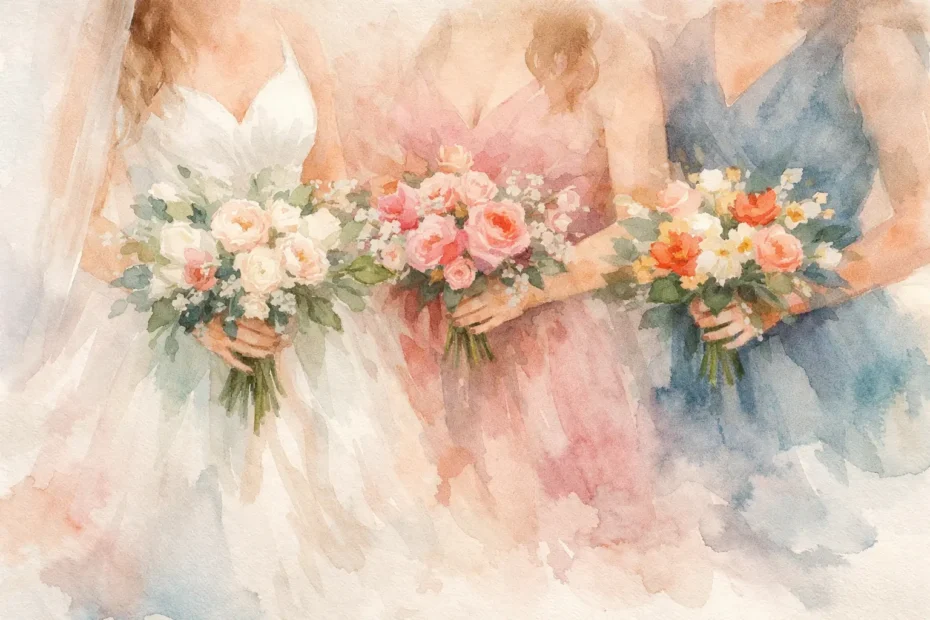
A row of bridesmaids holding identical bouquets can be beautiful, but it is not the only beautiful answer. Do bridesmaids bouquets have to match? Not at all. They simply need to feel connected to the wedding you are creating – from the colors in your ceremony space to the personality of the people standing beside you.
For some couples, matching bouquets create a polished, classic picture. For others, a thoughtfully varied collection of blooms feels more personal, more natural, and much more memorable. The right choice is the one that supports your story rather than following a rule that does not fit your celebration.
Do Bridesmaids Bouquets Have to Match Exactly?
No. Bridesmaid bouquets can match exactly, share a common formula with subtle differences, or be individually designed within a cohesive floral palette. Each approach can look intentional when the flowers, colors, scale, and styling are considered as one complete design.
The key is coordination, not duplication. A wedding party can carry different bouquets while still looking beautifully united in photographs. Perhaps each bouquet includes the same soft ivory ranunculus and wisps of delicate foliage, while one features blush garden roses and another carries warm apricot tulips. The flowers are not identical, but the overall feeling remains harmonious.
This is especially lovely for couples drawn to garden-inspired wedding flowers. Nature rarely repeats itself perfectly. A varied floral collection can bring movement, depth, and a gathered-from-the-garden romance to the bridal party.
When Matching Bouquets Make Sense
Matching bouquets are a wonderful choice when you want the wedding party to feel formal, timeless, and visually streamlined. They also work beautifully when bridesmaid dresses are already varied in color or fabric. Repeating one bouquet design can bring calm to a more layered look.
A matching bouquet approach is often ideal for a traditional ceremony, a black-tie celebration, or a wedding with a tightly edited color palette. Imagine sleek bridesmaid dresses in deep emerald, each paired with the same compact bouquet of white roses, Italian ruscus, and delicate white blooms. The repetition gives the group a refined, confident presence.
There is a practical benefit, too. One repeated recipe is generally easier to source and design consistently, particularly if you have a larger wedding party. That does not mean it has to feel generic. A custom floral designer can still select blooms, textures, ribbon, and proportions that feel distinctly yours.
When Mismatched Bouquets Feel More Personal
Varied bridesmaid bouquets make sense when individuality is part of your wedding vision. They are a natural fit for garden weddings, estate celebrations, artistic color palettes, and bridal parties wearing different dress colors or styles.
The variation can be subtle. Each bouquet may have the same overall shape, size, and palette, with a different focal flower. One bridesmaid might carry white sweet peas and pale blue delphinium, while another has creamy roses and soft lavender stock. From a distance, the group reads as one thoughtful floral moment. Up close, every arrangement has its own character.
You can also use varied bouquets to make dress colors feel intentional. If your attendants are wearing shades of champagne, rose, sage, and muted blue, a single bouquet recipe may not flatter every look equally. A florist can adjust the flower mix slightly so each person is complemented while the group still belongs together.
This approach can feel particularly meaningful when you want to honor the people around you. Different flowers can reflect individual personalities without turning the wedding party into a collection of unrelated arrangements. The design still needs a clear floral language: shared tones, repeated textures, or a consistent ribbon treatment.
How to Make Different Bridesmaids Bouquets Look Cohesive
If you love the idea of variety, choose a few design anchors before choosing individual flowers. A common color story is usually the strongest starting point. You might work within warm sunset tones of butter yellow, peach, coral, and soft pink, or a quiet garden palette of ivory, blue, lavender, and fresh green.
Then consider shape and scale. Bouquets do not need to contain the same flowers, but they should generally feel like members of the same family. A large, dramatic cascading bouquet beside several petite, compact posies can look unbalanced unless that contrast is a deliberate part of the overall design.
Repeating one or two elements creates a lovely visual thread. This may be a particular rose, a blue accent flower, airy foliage, or trailing silk ribbon in the same shade. Even when every bouquet is slightly different, those repeated details tell the eye that the arrangements belong together.
It also helps to give the bride’s bouquet a clear role. Your bouquet can be fuller, more textural, or feature a few special blooms that do not appear anywhere else. The bridesmaids’ flowers should complement it rather than compete with it. Think of their bouquets as a beautiful supporting chorus to your leading arrangement.
Consider the Full Wedding Picture
Bouquets are only one part of the floral story. Ceremony arrangements, boutonnieres, reception centerpieces, and even floral accents on the welcome sign can help carry your palette from one moment to the next.
For example, if bridesmaids carry varied arrangements in soft pink, peach, and ivory, those colors might reappear in your ceremony flowers and on reception tables. The floral design then feels cohesive across the day, even if no two bouquets are identical.
This broader view matters for photography as well. A thoughtful florist designs with individual portraits, group photos, ceremony moments, and reception details in mind. The goal is not to make every image perfectly symmetrical. It is to create a wedding that feels beautifully considered from every angle.
A Few Details That Influence the Decision
Seasonality can shape how much variation makes sense. If you are dreaming of a specific flower that is limited, using it in every bridesmaid bouquet may be less practical than featuring it in just a few. A flexible palette lets your florist preserve the feeling you love while working with the freshest, most beautiful blooms available.
Budget is another consideration. Different bouquets are not automatically more expensive, but a highly specific recipe for each person can require more planning, sourcing, and labor. If you want a varied look, ask your floral designer to create a shared framework first. A mix of complementary blooms within a defined palette often delivers the custom feeling you want without unnecessary complexity.
Comfort matters, too. Bridesmaids will carry these flowers during portraits, the ceremony, and plenty of hugs. A bouquet should suit the person holding it and feel balanced in scale. If one attendant is petite and another is tall, slight differences in proportion can look more flattering than identical arrangements.
Questions to Bring to Your Floral Consultation
Bring a few images that reflect the feeling you want, but do not worry if the bouquets in those images do not match exactly. What matters most is identifying what you are drawn to: the softness of the palette, the looseness of the shape, the flower varieties, or the sense of color movement.
It is helpful to share your bridesmaid dress swatches, wedding venue details, and any meaningful flowers you hope to include. A garden-inspired design for a spring celebration in the Tinley Park area may call for a different balance of blooms than a richly layered fall reception. Those details give your florist the context to recommend whether matching or varied bouquets will serve your vision best.
At An English Garden Wedding & Event Florals, we see bouquets as more than a bridal-party accessory. They are small, living pieces of the celebration – held close during the vows, carried into the photographs you will return to for years, and designed to make every person standing beside you feel part of the story.
Choose matching bouquets if their clean repetition makes your heart happy. Choose coordinated variety if you want every arrangement to feel a little more expressive. The loveliest floral choice is the one that makes your wedding party feel connected, your photographs feel like you, and your celebration bloom with personality.