
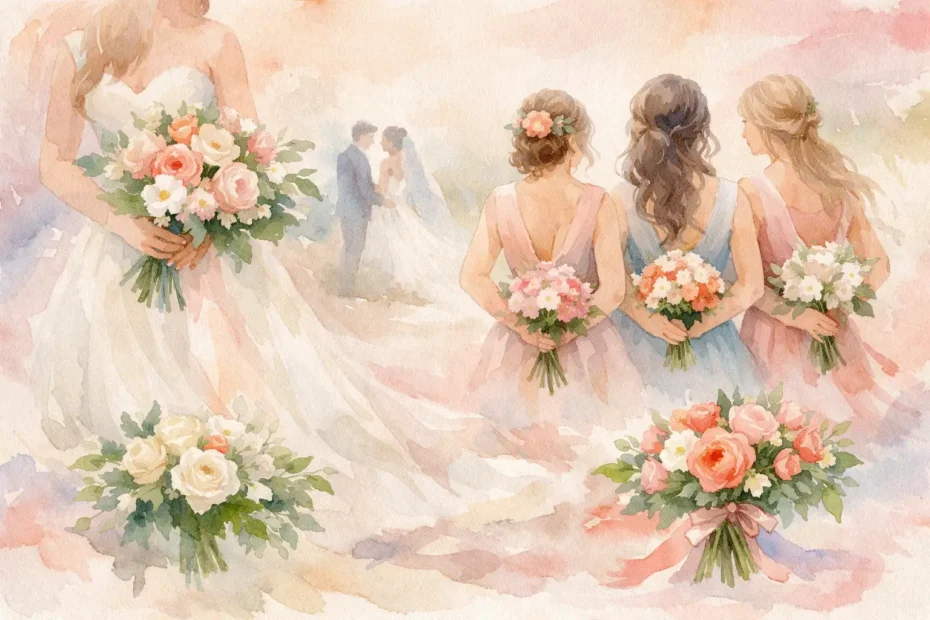
A bridal bouquet may be the arrangement everyone remembers, but the smaller bouquets surrounding it create the full picture: the friends at your side, the joyful walk down the aisle, and the photographs you will hold onto for years. If you are asking “how many bouquets for wedding party” members, start with the people who will carry flowers during the ceremony. From there, your floral count can become more personal, practical, and beautifully intentional.
The Simple Answer: Count Everyone Carrying Flowers
For most weddings, you will need one bouquet for the bride and one bouquet for each bridesmaid or matron of honor. If you have a maid of honor, she receives her own bouquet, often designed with a subtle distinction such as a fuller shape, a slightly different ribbon, or a few special blooms that echo the bridal bouquet.
That means a wedding party with one bride, one maid of honor, and four bridesmaids typically calls for six bouquets. A bride with three bridesmaids and no separate maid of honor would need four. The count itself is straightforward, but the design decisions behind it deserve a little more thought.
Your wedding party flowers should feel like part of one visual story. The bridal bouquet usually leads that story with the most texture, movement, and variety. Attendant bouquets can be smaller and more streamlined while still carrying the same color palette, foliage, and seasonal character. This approach lets your bouquet feel special without making the entire floral plan feel disconnected.
How Many Bouquets for a Wedding Party With Special Roles?
Not every loved one in your wedding needs a full bouquet. The right choice depends on their role, their comfort, your budget, and the overall look you want to create.
A junior bridesmaid often carries a smaller bouquet that coordinates with the adult attendants. It should feel celebratory and age-appropriate, not like an afterthought. A petite hand-tied bouquet or a simple nosegay can photograph beautifully while being easy for a younger person to hold.
Flower girls are another place where couples can choose something other than a traditional bouquet. A small flower crown, a floral wand, a pomander ball, or a basket of petals may better suit the moment. Some flower girls do carry petite bouquets, especially when they are older or when the wedding party has a more formal style. There is no rule that says every person walking down the aisle must hold the same type of flowers.
Mothers, grandmothers, readers, officiants, and ceremony musicians generally receive corsages, boutonnieres, or personal flowers rather than bouquets. If a mother is walking in as part of a formal processional and you love the idea of giving her something to carry, a delicate petite bouquet can be a lovely choice. It is simply an optional gesture, not a required wedding expense.
Start With a Personal Flower Headcount
Before choosing bloom varieties or bouquet sizes, make a list of every person receiving personal flowers. This makes it easier to see which roles need bouquets and which call for another floral detail.
For a typical wedding, your list may include:
- One bridal bouquet
- One bouquet for each maid, matron, or person of honor
- One bouquet for each bridesmaid
- Petite bouquets or floral alternatives for junior attendants and flower girls
- Corsages and boutonnieres for family members and other honored guests
This list also helps when your plans shift. Perhaps a sibling joins the wedding party late, a reader becomes an attendant, or two friends are sharing a role. Your florist can adjust the count and guide you toward designs that still feel cohesive.
Bouquet Size Matters as Much as Bouquet Quantity
Six bouquets can look completely different from one wedding to another. A party of six carrying lush, garden-style arrangements with roses, ranunculus, sweet peas, and trailing greenery has a very different floral footprint than six compact white calla lily bouquets.
When you are planning, think beyond the number of bouquets and consider the visual balance between them. A grand, airy bridal bouquet can pair beautifully with modest attendant bouquets, particularly if you want the bride to stand out in photographs. On the other hand, a fashion-forward wedding party dressed in one color may call for fuller, more expressive bouquets that make a statement together.
Venue scale matters, too. In a large church or an open outdoor ceremony space, slightly fuller bouquets can read well from a distance. For an intimate garden ceremony or a modern restaurant wedding, smaller designs may feel more natural and refined. The goal is not to make every bouquet identical. It is to create harmony between the flowers, attire, setting, and feeling of the day.
Do You Need Matching Bridesmaid Bouquets?
Matching is not the only path to a polished wedding party. Bridesmaids can carry the same bouquet design, which creates a classic, unified look. They can also carry coordinated bouquets with slight variations in color or flower variety. This is especially lovely when each attendant is wearing a different dress color or when you want a collected-from-the-garden feeling.
For example, a bridal party in soft blue, dusty rose, and champagne might carry bouquets built from a shared recipe of ivory blooms, garden roses, delicate blue accents, and textured greenery. One bouquet may lean blush, another may feature more blue, but all belong together. The result feels thoughtful rather than overly matched.
If you are trying to manage your floral investment, uniform attendant bouquets are often easier to plan and can reduce the complexity of ordering specific stems. Variation can be beautiful, but it may require more flower types and more design time. A good floral designer will help you decide where custom details will make the greatest impact.
Consider What Happens After the Ceremony
Bouquets do more than fill the walk down the aisle. They appear in getting-ready photos, ceremony photos, family portraits, and often reception photographs. Planning where they will go after the ceremony can give those flowers a second moment to shine.
Bridesmaid bouquets can be placed in vases at the head table, sweetheart table, cake table, bar, welcome table, or lounge area. This can add softness and color to the reception without ordering separate arrangements for every surface. Just be sure to designate someone to collect them after photos and place them where they belong.
If you plan to repurpose bouquets, tell your florist early. The reception design can be created with those arrangements in mind, and the floral team can recommend easy placements that still look intentional. Repurposing works best when it supports the design rather than replaces essential ceremony or reception flowers.
A Few Real-World Scenarios
A bride with a maid of honor, four bridesmaids, and one flower girl may order six bouquets if the flower girl carries a petite bouquet. If the flower girl has a petal basket instead, the total becomes five bouquets.
For a wedding party made up of a person of honor and three attendants on each side, only the people carrying bouquets need to be counted in the bouquet total. The others may wear boutonnieres, carry no flowers, or choose another personal floral accent that fits their attire and role.
For mixed-gender wedding parties, let the person and their outfit guide the choice rather than tradition. Some attendants may love carrying a bouquet. Others may prefer a boutonniere, a pocket floral, or a small floral pin. The flowers should help every member of your party feel included and comfortable.
Let Your Flowers Reflect the People Beside You
There is no prize for ordering a bouquet for every possible role, and there is nothing incomplete about choosing only the arrangements that matter most. Your wedding party floral count should honor the people standing with you while leaving room for your priorities, your budget, and your vision.
At An English Garden Wedding & Event Florals, we believe personal flowers should feel like a natural extension of your celebration: crafted with care, designed around your story, and memorable from the first photograph to the final dance. When you choose each bouquet with intention, even the smallest arrangement becomes part of the happiness surrounding your day.