
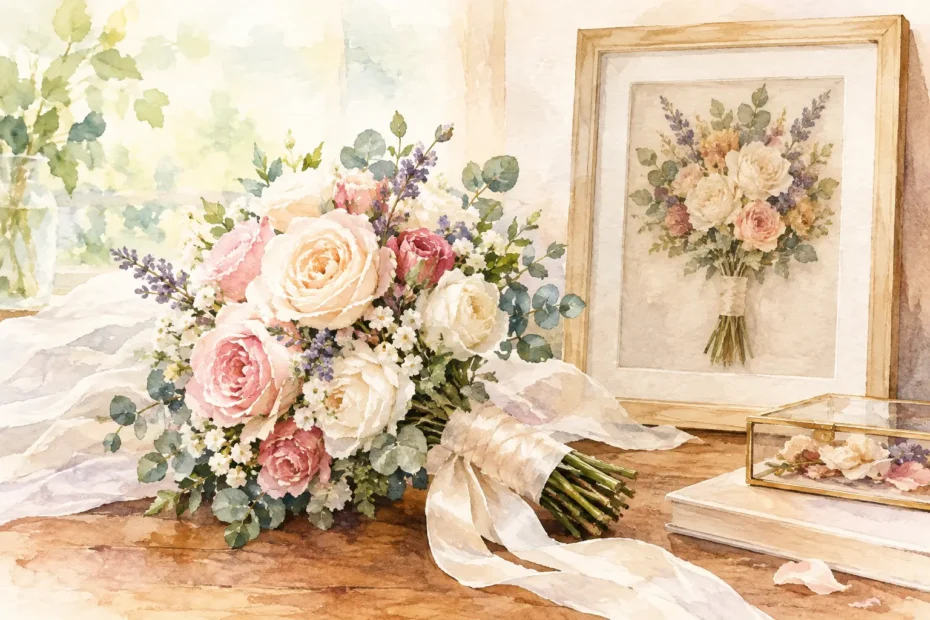
The morning after your wedding, your bouquet can feel almost too meaningful to set down. It carried you down the aisle, appeared in the photos you will revisit for decades, and held the colors and textures chosen to tell your story. If you are wondering how to preserve your bridal bouquet, the best answer begins with one simple truth: start while the flowers are still fresh.
A preserved bouquet will not look exactly as it did on your wedding day. Fresh flowers are fleeting by nature, and that is part of their beauty. But with the right method, you can keep their shape, color, and sentiment in a lasting form that feels just as personal as the celebration itself.
Preserve Your Bridal Bouquet Before It Fades
The first 24 to 72 hours matter most. Flowers begin to soften, brown, and lose their form quickly once they are out of water, particularly after a long day of photographs, hugs, warm rooms, and dancing. If bouquet preservation is part of your plan, decide on a method before the wedding rather than trying to make that decision after the last dance.
Ask a family member, wedding party member, or trusted friend to take responsibility for your bouquet once portraits are finished. Until it is ready to be preserved, keep it in clean water in a cool room away from direct sunlight, heating vents, and ripening fruit. Fruit releases ethylene gas, which can speed up the aging process in flowers.
Take a few clear photos of the bouquet from every angle, including a close-up of the ribbon wrap and any meaningful accents. This is especially helpful if you plan to take the bouquet apart for drying or pressing. A photo gives you a beautiful reference if you want to recreate its overall shape later in a frame or display box.
Choose the flowers that matter most
You do not have to preserve every stem to preserve the heart of the bouquet. In fact, a full arrangement can be difficult to dry evenly, especially if it includes dense blooms, greenery, and flowers with delicate petals. Choose several statement flowers, a small cluster of accent blooms, and a piece of the ribbon. A rose from your grandmother, a peony you had dreamed of carrying, or a sprig of greenery that tied into the ceremony design can become a meaningful keepsake.
When we design wedding flowers at An English Garden Wedding & Event Florals, we encourage couples to consider their preservation hopes while selecting blooms. Some flowers hold their form beautifully, while others are better remembered in photographs or pressed petals. Roses, ranunculus, spray roses, lisianthus, statice, and many textural grasses are often lovely candidates. Hydrangea, orchids, anemones, and very open garden roses can be more delicate, though a professional preservation artist may still be able to work with them.
How to Preserve a Bridal Bouquet: Choose Your Method
The right preservation method depends on the flowers, your budget, the look you love, and how you hope to display the finished piece. A softly faded, heirloom-style bouquet has a very different feeling from flowers that retain much of their original color in a modern shadow box.
Professional freeze-drying for the closest-to-fresh look
Professional freeze-drying is often the best choice for couples who want to preserve the dimension of their blooms. A preservation specialist carefully dries the flowers under controlled conditions, helping many petals hold their shape and much of their color. The flowers can then be arranged in a shadow box, glass cloche, display case, or framed design.
This is a wonderful option for a bouquet with roses, peonies, ranunculus, or other full blooms that you want to recognize immediately. It is also the most hands-off option after the wedding, but it requires advance planning. Most specialists need the bouquet delivered or shipped very soon after the event, and the process is typically more expensive than preserving flowers at home. The final flowers are still delicate, so they should be displayed away from moisture and direct sun.
Dry flowers with silica gel at home
Silica gel is a practical at-home method for preserving individual blooms with more shape and color than air-drying usually allows. It is especially useful for smaller flowers and blossoms you would like to arrange later in a frame.
Start by trimming selected blooms from the bouquet, leaving a short stem if you would like one. Place them upright in an airtight container and gently pour silica gel around and between the petals until each bloom is fully covered. Seal the container and leave it undisturbed for several days, checking carefully based on the flower type and the product directions.
When the flowers are dry, remove them slowly with a soft brush or spoon. Their petals may be brittle, so this is not a project to rush. Silica-dried blooms are beautiful in a shadow box with a wedding invitation, a handwritten vow excerpt, or a small section of bouquet ribbon.
Air-dry for a romantic, timeworn finish
Air-drying gives flowers a naturally softened, old-world character. The colors will deepen, mute, or turn slightly sepia over time, which can be lovely for a garden-inspired wedding palette. This method works well for roses, statice, lavender, eucalyptus, baby’s breath, and other sturdy flowers.
Remove excess leaves, make small bundles, and hang the stems upside down in a dry, dark, well-ventilated area for two to three weeks. Avoid a damp basement, bathroom, or laundry area. In the humid suburban Chicago summer, moisture can cause flowers to droop or develop mold before they dry properly.
Air-drying an entire tightly bound bouquet is possible, but it comes with trade-offs. The center flowers may not receive enough airflow, and the arrangement can dry unevenly. Preserving a few smaller bunches or selected stems usually creates a cleaner result.
Press meaningful flowers and petals
Pressed flowers are ideal if you love a delicate, botanical look. Because the flowers dry flat, this method is best for petals, small blooms, greenery, and flowers with a naturally flatter face. A pressed-flower frame can feel wonderfully personal without requiring you to keep a full three-dimensional bouquet.
Place flowers between sheets of absorbent paper inside a heavy book or flower press. Keep the layers dry and replace the paper if it becomes damp. After two to four weeks, the flowers should be dry enough to arrange in a floating frame, a matted piece of art, or a keepsake album.
Pressing is also a thoughtful solution for blooms that may not hold their shape well when dried upright. Even a few petals from a favorite flower can become a quiet, beautiful reminder of the day.
Be thoughtful about resin preservation
Resin can create a dramatic keepsake, such as a clear block holding a single bloom, a ring dish with petals, or an ornament with tiny floral details. However, resin does not preserve fresh flowers on its own. Flowers must be completely dry first, or moisture can lead to browning, bubbles, or deterioration inside the piece.
Resin also has limits. It can yellow over time if exposed to sunlight, and larger pieces require skill to avoid heat damage and trapped air. If you love this look, consider preserving one or two fully dried blooms rather than trying to encase your full bouquet.
Create a Display You Will Actually Enjoy
Your preserved flowers deserve a place where you will see them. A shadow box near your wedding photographs, a pressed-flower frame in your bedroom, or a petite cloche on a bookshelf can keep the memory present without feeling overly formal. Pairing flowers with a ribbon wrap, invitation, date, or handwritten note makes the piece feel distinctly yours.
Protect finished flowers from direct sun, high humidity, and frequent handling. UV-protective glass is helpful for framed pieces, while a display case can reduce dust on three-dimensional flowers. Avoid hanging preserved florals in a steamy bathroom or placing them on a sunny windowsill, no matter how tempting the light may be.
Your bouquet was designed for one remarkable day, but the story it carries does not have to end when the petals begin to change. Choose the preservation approach that fits your home, your style, and the flowers you loved most, then let that small piece of your celebration keep bringing happiness into the years ahead.